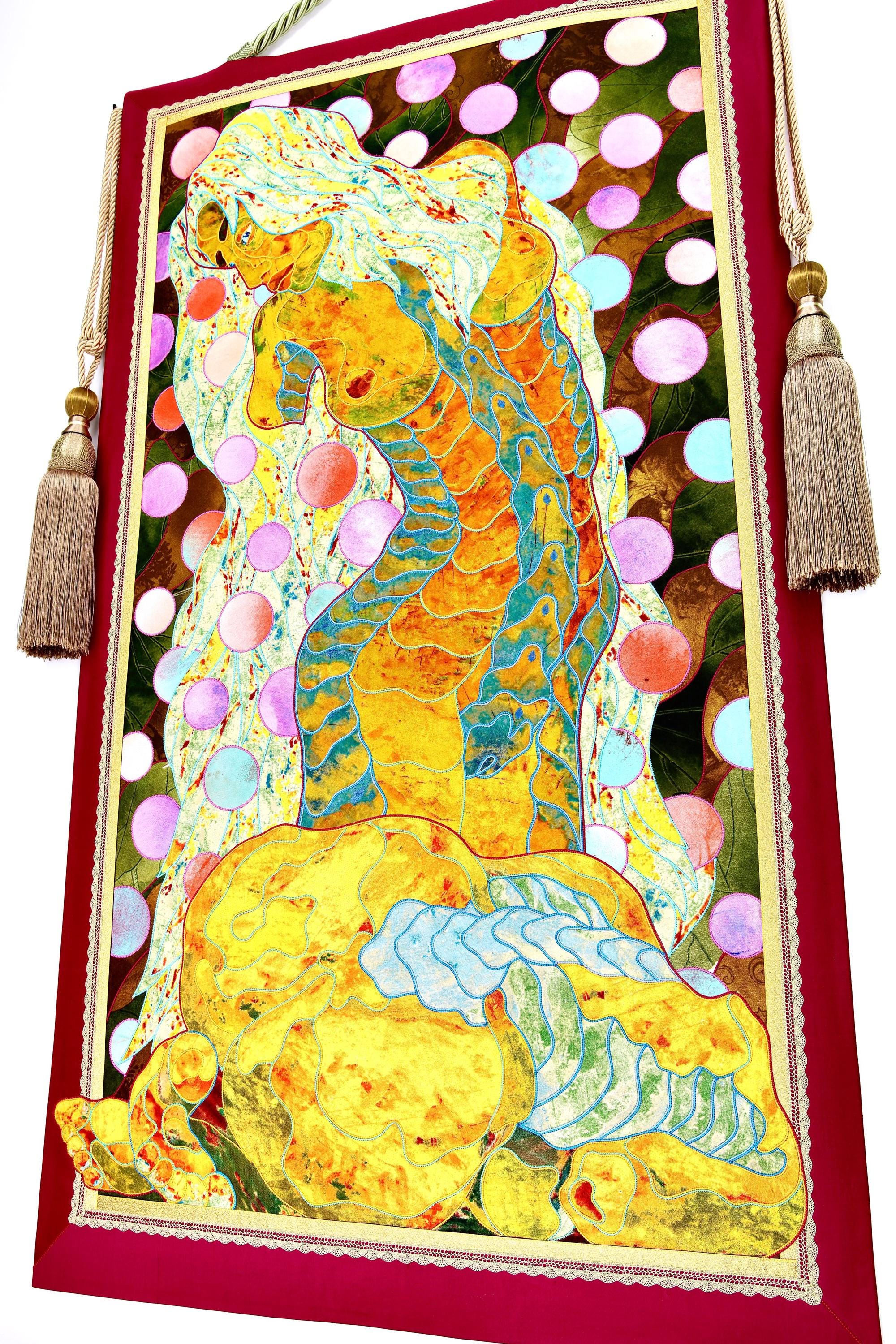
The art of silk embroidery in the world of collectibles
Unlike a painted surface, silk thread reflects and refracts light due to its thousands of fine fibers. A piece of embroidery can appear deep and vibrant from one angle, and silver or translucent from another. This shifting quality gives large-scale textile art a dynamic presence without being overwhelming - particularly valuable in interior spaces, where the work needs to be appreciated up close, while still making an impact across the room.The direction of the stitches influences the nature of the light. Horizontal threads create a calm and broad area of color, while vertical or curved lines enhance the sense of movement in faces, animals, garments, or botanical details. Densely stitched areas produce richness and opacity, while more open areas allow the background to contribute. The best results are not always about covering everything - a more restrained approach creates air, shadow, and distance that a uniformly worked surface can't achieve.The artist should also take into account the direction of the threads. They should not be placed too closely together, as this could make the image look flat. Instead, they should be spaced out in order to create a sense of depth. Additionally, the artist should consider the color of the threads. It is important that they are not too bright, as this could result in an over-saturated image. Instead, muted colors should be used to create a more natural look and feel.In the world of textile art, a stitch can be seen as a line of drawing. It can follow the contours of the cheek, the fabric's drape, the hand's tension, or the animal's fur. When the direction of the thread is varied intentionally, the image gains depth without the need for literal modeling in every detail.This is especially true in portraits and animal-inspired images. A slight variation in the stitch pattern can suggest the presence of bones, muscles, feathers, or fur. The surface still looks like embroidery, but the image becomes more realistic because the lines understand form. This method is slower and more careful than simply filling in shapes with threads.To create vibrant colors, silk embroidery artists often layer different threads. They carefully manipulate the colors to create subtle overlays and adjust the thread density.A darker thread next to a lighter one can create a shadow that seems to recede, while a fine highlight brings a feature forward with remarkable precision. However, this process takes time, as the complex modulation of colors requires repeated decisions. Each choice is visible on the finished surface, which is why hand-embroidered silk works have a visual intelligence that can't be replicated by printed or machine-made reproductions. The variations in the work aren't flaws to be hidden; they're evidence of a skilled hand guiding the material in real-time. Even tension is essential, although achieving perfect flatness isn't always the goal. In some areas, the surface is deliberately raised to intensify a focal point or create contrast with quieter, recessed sections. The interaction between raised and flat elements give the embroidered tapestry its three-dimensional quality.Excessive texture in an image can make it visually overwhelming, especially in a refined interior space. On the other hand, too little texture can reduce a silk fabric to a simple decorative surface. Finding the perfect balance lies in selectively emphasizing certain areas: a concentrated detail, a controlled shine, and a generous background that allows the eyes to rest.For collectors, it is not necessary to know every single stitch in order to appreciate quality. Instead, start by observing the artwork from different distances. From a distance, the composition should look clear and confident. When viewed up close, the threads should reveal subtle variations in color, direction, thickness, and texture.Consider the connection between the subject and the material. In a powerful textile artwork, silk should not be seen as a substitute for an image that could have been painted or printed. Instead, the work should rely on luminosity, texture, and handcrafted details as essential components of its meaning.A figure may appear more personal because it was created through countless physical decisions. The changing texture of silk can give an animal presence.The size of the work is also important. A large silk tapestry can become the centerpiece of an entrance, living room, master suite, or boutique hotel. The dimensions should be considered, as well as the viewing distance and surrounding architecture.If the wall is large, it can support a work with tonal depth. If the space is more intimate, a piece with concentrated detail may be better appreciated up close.The provenance and the artist's identity are both important factors in determining the value of a collectible textile artwork. When associated with a recognized artistic practice and a known creator, it gains additional value as a unique, handcrafted piece rather than a mass-produced decoration. This distinction enhances the emotional value of owning the artwork and ensures the long-term integrity of a collection.When placing silk art in a room, it is important to consider the lighting conditions. Indirect natural light brings out the natural variations in tone of the silk, while carefully positioned low-heat lighting reveals its texture in the evening. Direct sunlight should be avoided, as it can affect the color of delicate textiles over time. Instead, a designer should consider how the light will change throughout the day, rather than evaluating the artwork under a single light source.The most effective placements for artwork provide it with a generous amount of visual space. Silk, with its intricate details, lustrous appearance, and depth, does not need to compete with crowded shelves or patterned furnishings. Against a background of plaster, warm white paint, dark wood, stone, or a subdued architectural palette, it can make a striking impression.Care for the artwork is straightforward but must be done carefully. Avoid exposing it to humid environments, direct sunlight, or improper cleaning methods. When dusting, be gentle and avoid contact with the surface. For significant works, framing, mounting, and installation should preserve the integrity of the textile and present it as a work of art rather than an accessory.In the work of Konstantin Malginov, silk is used as a medium for creating both visual and sculptural pieces that are intimate in their composition but imposing on a large scale. This combination is at the heart of their appeal: each thread contributes to a surface that changes with the viewer, light, and environment.The meticulously crafted silk tapestries demand attention rather than a quick glance. Place them in a space where their shifting surfaces can be seen in the morning light, evening shadows, and quiet moments in between - the moments when the finished work becomes a part of the overall experience of the space.