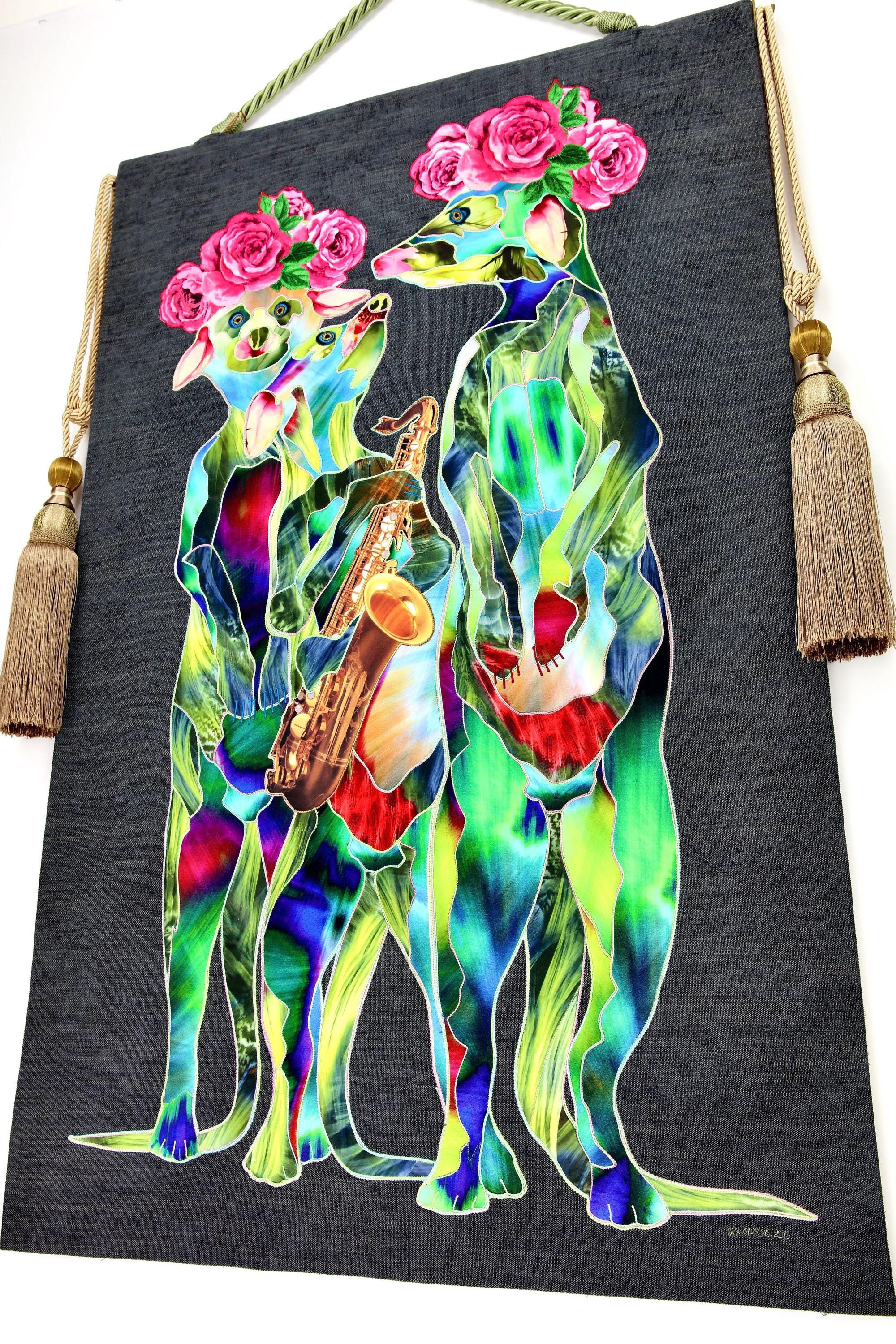
Questions for collectors regarding the authentication of artworks.
The first and most important question is: who is the creator of this work and how can we verify their authorship? For artists who are still living, the most reliable source of information often comes from the artist themselves or their official studio. If you purchase a work directly from the artist, you have a clear chain of ownership, as the work moves directly from the artist to you without any intermediaries or anonymous resales.Ask about the signature, title, and date of the work and where they are located. While a signature alone may not be a definitive proof of authenticity, it is still an important piece of information. In textile-based works, identifying marks can be found on a reverse label, certificate, or official studio document, instead of on the front of the piece. This does not mean that there is something wrong with the work; it simply reflects the nature of the medium and the artist's preferred method of presentation.Next, ask about the uniqueness of the artwork. Is it part of a limited edition or a variation within a specific series? These terms should be used accurately. A one-of-a-kind silk tapestry has a different collecting profile than an editioned work, even if both are genuine.If the artwork is part of an edition, ask for the total number of copies, the number of artist's proofs (if any), and clarification on whether the materials and dimensions are consistent across all copies.Remember, the goal is not simply to gather paperwork. It's to understand what you're acquiring: a unique physical object with its place in the artist's body of work and evidence connecting it to the creator.Provenance is the record of an artwork's journey from its creation to the current owner. For newly acquired works, the story is usually straightforward: the artist, their studio, and the collector. For older or resold pieces, the provenance may include galleries, exhibitions, private collections, auction records, invoices, and published references.While a brief provenance may not always be a cause for concern, it is important to ensure that the history is credible and consistent with the work's age and market history. A contemporary piece may have been owned by its original owner since its creation, but it is crucial to verify the authenticity and legitimacy of the information provided.If there are any gaps in the provenance of an artwork, the seller should be able to explain them clearly. A modest gap that can be explained reasonably is different from a history that changes with each conversation. Reliable sellers don't treat provenance as a mystery. They provide the necessary documents, distinguish between facts and assumptions, and acknowledge what can't be confirmed.Collectors who purchase directly from an artist's studio receive every original document from the beginning. Invoices, certificates of authenticity, condition reports, delivery correspondence, and installation instructions form the first part of the artwork's provenance. Digital copies should be stored in multiple locations, and the physical original should be kept with important collection records.When considering the certificate, it's important to understand what it actually proves.A certificate of authenticity is an important document that clearly identifies a work of art. It should include the name of the artist, the title of the piece, the date it was created, the medium used, and any other relevant details. It should also state whether the work is a one-of-a-kind piece or part of a limited edition.The certificate should be signed or issued by a reputable studio or representative to ensure its authenticity. This helps to prevent confusion and misattribution of works.While a certificate is important, it is not the only way to verify the authenticity of a piece. It should be used in conjunction with other forms of evidence such as provenance (the history of ownership), visual inspection, and trust in the vendor.Generic certificates with vague descriptions or incorrect information should be approached with caution. It's important to carefully examine the certificate before making any decisions about a piece of art.For a large textile piece, it is essential to accurately record the dimensions in both inches and centimeters. This information is beneficial not only for planning the installation, but also for future reference. Even a small discrepancy in dimensions could indicate a separate work, variant, or cataloging error that must be resolved prior to purchase.Expert knowledge of materials is crucial for authentication. The intricate details of a tapestry's surface and structure provide valuable information. To gain a more detailed description, ask about the specific material used. Was it hand-embroidered silk, silk applique, a combination of materials, or printed textile? Are there additional materials, hand-finished elements, or sculptural components? "Silk artwork" can refer to a wide range of items, so collectors should be prepared for precise language.The clarity of the materials used ensures both the aesthetic appeal and the durability of the work. Silk, when handmade, exhibits subtle imperfections that add to its charm: variations in stitch direction, subtle differences in sheen, and a surface that changes depending on the angle of light. These features are distinct from manufacturing errors.However, sellers should not use the term "handmade" as a vague answer to a specific question about the production process. Instead, they should provide detailed information about the materials and techniques used.To ensure a better understanding of the product, please provide high-resolution images of the front and back, as well as any signature or label. Close-up images of the construction details would also be helpful. For major purchases, in-person viewings are preferred, as the scale, texture, and shine of silk can only be fully appreciated in person. If viewing is not possible due to distance, professional studios can provide clear images and detailed descriptions.